
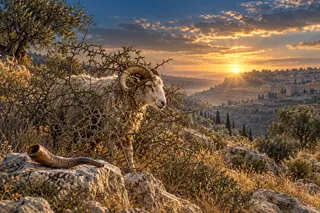
There is something special about Rosh Hashanah. The Torah does not call it by that name, but “Yom Teruah,” a day of sounding the shofar, and “Zichron Teruah,” a remembrance through its sound. The shofar calls us to pause and remember who Adonai is, what he has spoken and promised, and what he has already done.
But what exactly are we to remember? And what does it mean when Scripture says the Holy One remembers?
When Scripture says the Holy One remembers, it does not mean he forgot something and suddenly recalled it. His remembrance acts. He rises to fulfill his word, attend to his people, save, and show chesed in keeping with his covenant.
That is why the readings for the two days of Rosh Hashanah fit this day so well. On the first day, we read about Yitzchak’s birth. The story opens with these words:
“Adonai attended to Sarah as he had said, and Adonai did for Sarah as he had spoken.”
Genesis 21:1
The Holy One had not forgotten Sarah or his promise. In the first day’s Haftarah, we also meet Channah, a woman in pain who prays from the depths of her heart. Then we read: “Adonai remembered her.” In both stories, divine remembrance brings life where human hope had run out.
Hineni: a heart ready to listen
On the second day, we return to the binding of Yitzchak. On that momentous day, Avraham answers three times with one word: “Hineni,” here I am. He says it when the Holy One calls him, when his son Yitzchak speaks to him, and again when Adonai’s messenger calls from heaven.
Hineni is more than a statement of location, as though Avraham were simply saying where he was. It is the answer of someone listening and ready to respond. Avraham listened when he was told to set out, and remained attentive enough to stop when the Holy One spoke again.
This is a good reminder at the beginning of a new year. Faith means more than knowing what was said in the past. It is a heart that stays open to God’s voice today. Sometimes obedience means getting up and going. Sometimes it means stopping and leaving undone what we thought we were supposed to do.
Where is the lamb?
Avraham and Yitzchak climb together toward the place God chose, Mount Moriah. Avraham places the wood on Yitzchak, and the son carries it up the mountain. Then Yitzchak notices something missing:
The Torah will return again and again to “the place Adonai will choose,” where he will cause his name to dwell and where Israel will bring their offerings. Many years later, the House of Adonai will be built on Mount Moriah. The binding does not happen in a random place. It leads us toward the place where sin, atonement, and sacrifice will stand at the center of Israel’s worship.
“Here are the fire and the wood, but where is the lamb for the burnt offering?”
Genesis 22:7
Avraham’s answer stays with us long after the story ends:
“God will see to the lamb for the burnt offering, my son.”
Genesis 22:8
God will see to it. He will see the need and himself provide the offering. Then we read again: “The two of them went on together.” Father and son continue together to the chosen place.
Yitzchak asks about a seh, a lamb or young animal from the flock. The word also brings us back to Pesach, the first annual appointed festival in the Torah. There, the blood of the lamb marks Israel’s homes, death passes over, and the people leave slavery for freedom. The lamb stands at the heart of the story of redemption.
At the decisive moment, Adonai’s messenger calls, “Avraham, Avraham.” Avraham answers again, “Hineni,” and is told not to lay a hand on the boy. Looking up, he sees a ram caught by its horns in a thicket. The ram becomes the offering in Yitzchak’s place.
The ram is found, but the question remains
The Holy One did provide a substitute for Yitzchak. Yet it is worth noticing a small detail. Yitzchak asked about a seh. Avraham said God would see to the seh. That day, what they found in the thicket was an ayil, a ram.
The ram answered the need of that moment, but Avraham’s words seem to look further ahead as well. He names the place “Adonai Yireh,” Adonai will see or provide, and the text adds: “As it is said today, on the mountain of Adonai it will be seen.”
What is still to be seen on the mountain of Adonai? And where is the lamb the Holy One himself will provide?
The shofar takes on another depth here. The ram’s horn recalls Yitzchak’s rescue and the substitute given in his place. But the story does not end with one person being saved. After the binding, the Holy One swears by himself and renews his promise to bless all the nations of the earth through Avraham’s offspring.
Within that oath, we hear again the words “your son,” “your only one.” Yitzchak is the son of promise, the beloved son Avraham did not withhold. Here we can recall another promise about a future son from David’s house. The Holy One says, “I will be a father to him, and he will be a son to me.” In the Psalms, he says to his anointed one, “You are my son.”
Who is this son, the promised son of David’s house, whom the Holy One calls “my son”?
The precious son God remembers
The second day’s Haftarah also brings us back to remembrance and the Father’s heart. Yirmeyahu speaks of Ephraim, of a people who need to return home, and says:
“Is Ephraim a precious son to me, a child in whom I delight? Whenever I speak of him, I still remember him. My heart yearns for him; I will surely have compassion on him.”
Jeremiah 31:19
This is the Holy One’s remembrance: full of compassion, never cold or distant. He remembers his precious son, his heart yearns for him, and he promises to bring him home.
The lamb God provided
When we bring the clues together, a larger picture begins to emerge: the father, the beloved son, the wood the son carries, the chosen place, the substitute, the lamb still awaited, the promised son of David, and the blessing for all peoples.
I am among those who believe this picture points to Yeshua, the lamb the Holy One himself provided.
On Mount Moriah, Yitzchak was spared because a substitute was given in his place. But when the Holy One gave his beloved Son for us, no substitute was given for him. As Shaul the emissary wrote: “He did not spare his own Son, but gave him up for us all.”
So the beginning of a new year rests on more than better resolutions from us. It rests on the chesed and faithfulness of the God of the covenant, on the lamb he provided, and on the invitation to hear his voice again and answer, “Hineni.”
Reflect and discover
Questions for reflection
- What do these readings teach us about how God remembers his promises and his people?
- What do we learn from Hineni about listening and obedience?
- How do Pesach and the promise of David’s son deepen Yitzchak’s question, “Where is the lamb?”
- What one step of trust or obedience is God inviting you to take as the year begins?
- Who could you share one thing you discovered with this week?
Prayer
Our Father in heaven
Thank you for remembering your covenant and acting with compassion. Give us attentive hearts that can answer “Hineni,” faith to trust you when we cannot yet see the way, and eyes to recognize the lamb you provided. Remember your people Israel, bring us back to you, and guide us in your light this year. Through the merit of Mashiach and in Yeshua’s name. Amen.
Shanah tovah u’metukah
Scripture excerpts are translated from this site’s Hebrew text. Full-reading links open the Complete Jewish Bible, which follows Hebrew verse numbering.