
Stories of New Identity · story 1 of 7
Simeon Bar Jonah, Called Kepha
Text ready to copy and share on WhatsApp
Copy the text and paste it into a WhatsApp conversation.
Your answers and personal notes are not included.
The reading
Read the passage in ScriptureLuke 5:4–11 · Matthew 16:13–19
The plain-language retelling helps us enter the passage. Scripture itself remains the source.
The story in plain languageAs close as possible to the text, in plain English
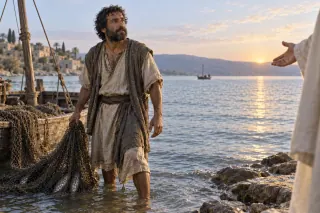
Simeon and his companions returned from another night of fishing on the Kinneret without catching anything. As they stood on the shore washing their nets, Yeshua got into Simeon’s boat and asked him to move a little way from land. From there, he sat and taught the people gathered by the water.
When he finished speaking, Yeshua told Simeon to go into deep water and let down the nets. Simeon reminded him that they had worked all night and caught nothing. Still, he said: if you say so, I will let down the nets.
This time they caught so many fish that the nets began to tear. Simeon and his companions signaled to their partners in the other boat to come and help. They filled both boats until they nearly sank under the weight of the fish.
When Simeon Kepha saw what had happened, he fell at Yeshua’s feet and said he was not worthy to stand beside him. He and everyone with him were astonished at the catch. So were Yaakov and Yochanan, the sons of Zavdai and Simeon’s partners. Yeshua told Simeon not to fear: from now on he would catch people. They brought the boats ashore, left everything, and followed him.
Some time later, near Caesarea Philippi, Yeshua asked his disciples who people said he was. They gave various answers: Yochanan the Immerser, Eliyahu, Yirmeyahu, or one of the prophets. Then he asked them directly: and you, who do you say I am?
Simeon Kepha answered: you are the Mashiach, the Son of the living God. Yeshua addressed him by name, Simeon Bar Jonah, and said this answer had not come from flesh and blood but from his Father in heaven. Then he said: you are Kepha, and on this rock I will build my community. He gave him the keys of the kingdom of heaven and spoke of what would be forbidden and what would be permitted.
Read, discover, live
Four steps to remember
No prior knowledge is needed. Read slowly, return to the story, and let the words meet everyday life.
Head
What do we understand?
- What do we see in the story?
- What does the story show us about God or Yeshua?
- What does it show us about people, and perhaps ourselves?
Heart
What speaks to us here?
- What speaks to me here?
- What caught my attention in the story? If you wish, pause and ask: Might the Spirit of God be drawing my attention to something here?
Hands
What will we do with this?
- What small, practical step could we take in the next 24–48 hours?
- Is there something to change, adopt, or do differently?
Feet
Where do we go from here?
- Who could we share the story with?
- Who could read it with me?
A small reading tip
As you read, you might look for:
- Something to believe
- A promise to receive
- Advice to put into practice
- Something God asks us to do
- Something that touched me, encouraged me, or was hard to read
To remember
Something you would like to take with you?
One place for anything you want to remember. It stays with you unless you choose to share it with our team.
Reading together?A simple meeting with family, friends, or a Yeshua Group

You can read on your own or invite friends. Reading together lets you hear what each person notices and how the same story touches different lives. Choose a story, read it, and explore the simple questions together.
Looking back
Begin the meeting together
How was the week? What are we thankful for? What was difficult, and how can we help? What happened with the step we chose last time?
Looking up
Read and discover
Read the story. One or two people retell it in their own words. Return to the text and to Head, Heart, Hands, and Feet.
Looking forward
Step into the week
Share what you hope to do, choose one step, think of someone to share with, and pray together for the week ahead.
Would you like to save your progress?
Private
Save and continue to the next story
You can use your first name, a nickname, both, or neither. A WhatsApp number is needed only to send the verification code.